
What Should a Truck Wrap Say to Get Calls?
Most wraps try to close the sale from the next lane. The ones that work make the name easy to remember for the day the need hits.
Short answer
Five things, in this order: your company name, your trade in a word, one promise you can be held to, a contact path, and where you work. A truck rarely gets the call on the road. Its job is recall: making your name the one a homeowner types when the need hits, instead of “near me.”
Why the usual advice falls short
The common advice is to make the phone number huge, list every service, and add “Call now.” It treats the truck like a billboard that has to close the sale at road speed. A passing driver gets about three seconds. Nobody writes down a phone number at a red light, and nobody finishes a list of eight services.
The call usually comes weeks later. The water heater leaks on a Sunday night, and the homeowner does one of two things: types a name they remember, or types “plumber near me” and sorts through strangers. A wrap built to close the sale on the road loses that moment, because it spent its three seconds on details nobody kept. A wrap built for recall wins it. Nobody calls a stranger.
More on that choice: When the need hits, do they search your name or “near me”?
The five things, in reading order
These are the five required elements of the 45 MPH Test, the standard WrapMasters applies to every wrap before it prints.
Your company name
The largest, cleanest thing on the vehicle. Everything else on the wrap exists to help this one element stick. If your logo mark is hard to read at a distance, set the name beside it in plain type.
Your trade, in a word
HVAC. Plumbing. Pest Control. A driver who cannot tell what you do has nothing to remember you for. One word, read with the name, beats a column of services nobody finishes.
One promise you can be held to
Specific and about one breath long. Done Once. Done Right. commits a company to something. Quality You Can Trust commits it to nothing, and every competitor on the road could say it too.
A contact path
When your web address is your business name, the name already is the contact path: anyone who can read the truck can find you. When the name and domain do not match, give the phone number real size, largest on the back.
Where you work
A city or service area tells a homeowner you are local, which is often the deciding detail when they later choose between a name they recognize and a stranger.
The same company, saying it two ways
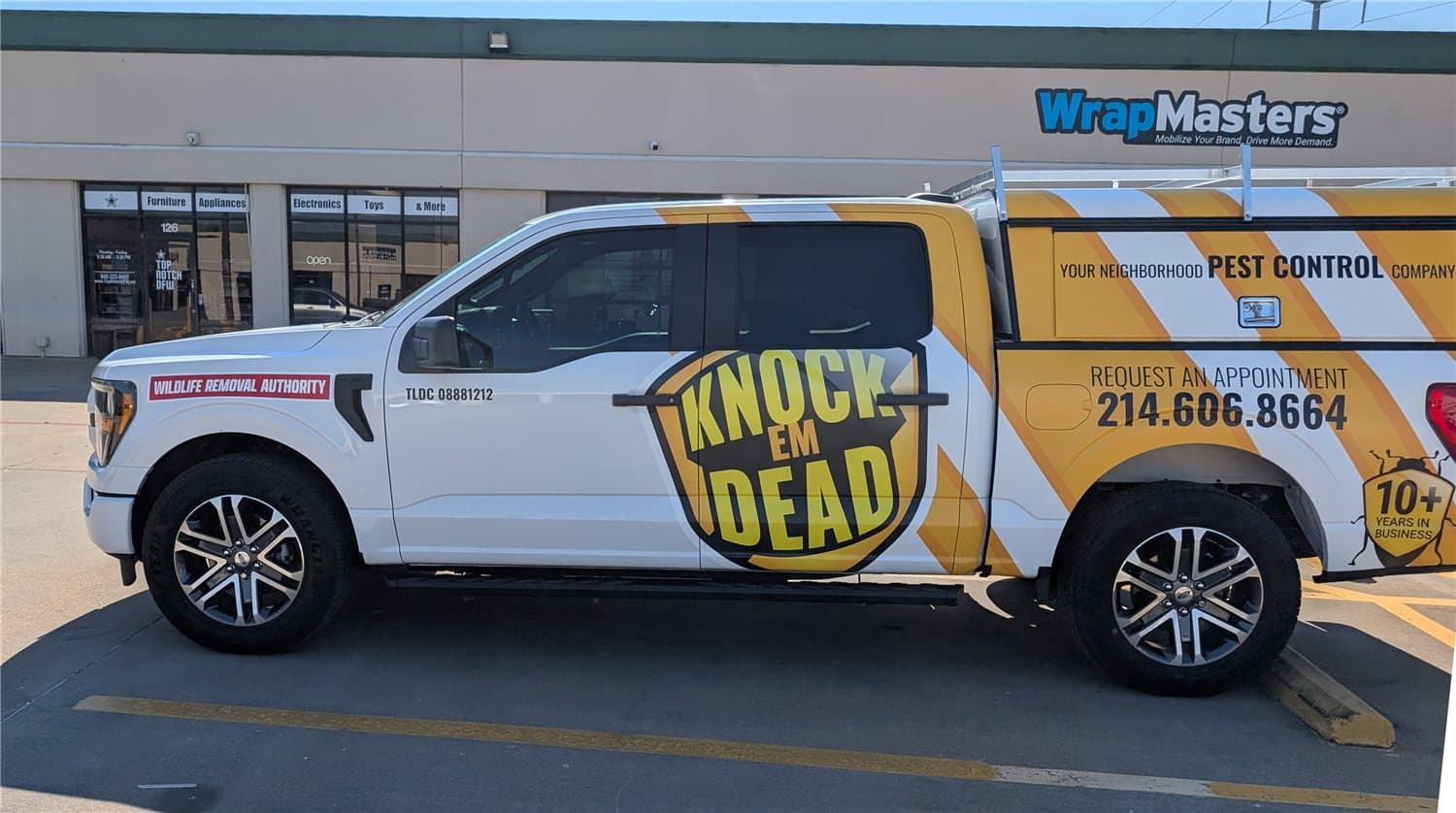
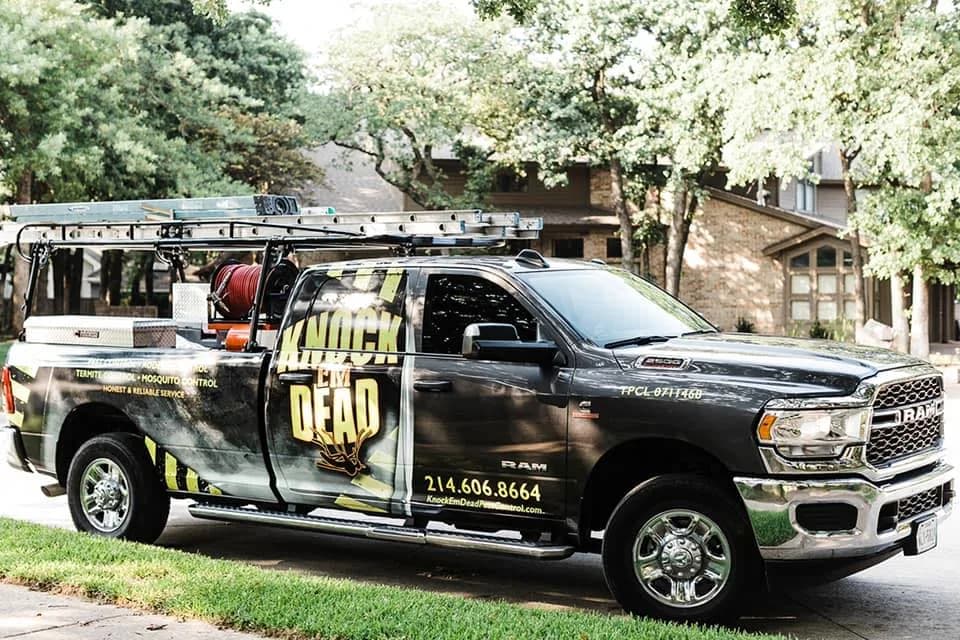
Knock Em Dead Pest Control grew from one truck to four in the 18 months after its rebrand, as reported by the owner. That is growth the business earned with its work, not a claim about what a wrap does on its own. The redesign made the name easy to recognize while it happened. Read the case study.
What to leave off
- A list of every service you offer. It reads as texture at speed. The list belongs on your website.
- Social media icons. Nobody follows a plumber from the next lane.
- Generic slogans like #1 in Service or Satisfaction Guaranteed. They exclude no competitor.
- Two phone numbers, a license number set large, and a web address that is not your name, all competing for the same three seconds.
The back of the vehicle has its own rules, because it gets the most reading time: What should be on the back of a service van?
Common questions
- What should a truck wrap say?
- Five things, in this order: your company name, your trade in a word, one specific promise, a contact path, and where you work. The name should be the most legible thing on the vehicle. Everything else supports it. A wrap that tries to say more than that usually says nothing a passing driver keeps.
- Do truck wraps actually get calls?
- Some calls come straight from a truck, especially from a driver stopped behind it. Most come later. A homeowner sees the same truck for months, and when the AC quits or a pipe bursts, they either search a name they remember or search near me and pick from strangers. A wrap that makes the name easy to read and remember wins more of those searches. Nobody can honestly promise a number of calls, and we do not publish one.
- Should the phone number be the biggest thing on my truck?
- Usually not. Nobody writes down a phone number at 45 MPH, so the name has to do the work of being remembered and searched. The exception is a business whose web address does not match its name, or whose customers call instead of search. Then the phone number needs real size, and the rear panel is where it gets read.
- Should I list all my services on my truck wrap?
- No. Name the trade in a word or two and put the full list on your website. A column of eight services competes with your name and is the most common reason a wrap fails the 45 MPH Test.
- What is a good slogan for a service truck?
- A promise a customer could hold you to, short enough to read in one breath. If breaking the line would not embarrass you, it is filler, not a promise. Done Once. Done Right. passes that test. Quality You Can Trust does not.
- How do I know if my current wrap says the right things?
- Upload a side or rear photo to the free Wrap Audit. It scores the vehicle against the 45 MPH Test, the published standard WrapMasters uses on every wrap it designs, and shows which of the five elements a passing driver can and cannot read.
Don't be a stranger.
See where your current wrap is losing visibility. Upload a side or rear photo and get an instant 45 MPH Test visibility score. Free, no commitment.
New business or no wrap yet? Get started instead, no audit needed.