
The 45 MPH Test
The operational standard WrapMasters applies to every wrap before production. Published in full, so anyone can run it on their own fleet.
A driver passing a service vehicle at 45 MPH has approximately three seconds of exposure if the vehicle is 100 feet ahead when it enters their field of view. In that window, the wrap has to communicate enough information to create a recognizable impression and ideally prompt a follow-up action.
Most vehicle wraps are never evaluated against this constraint. They are reviewed as flat files on a monitor, approved as renders on a mockup template, and signed off on in a parking lot at close range. None of those review conditions simulate what a passing driver actually experiences.
The 45 MPH Test is the design evaluation standard WrapMasters applies to every wrap before production. It grew out of two decades of building brands, then watching how they held up on the road, and it is the core inspection tool of the Stress-Test stage of Fleet-First Branding™. Nine checks: five for the elements on the vehicle, four for how the whole system holds together.
An operational standard, not a scientific claim
The wrap industry is full of precise-sounding numbers with nothing behind them. We hold ourselves to a different bar, so we want to be exact about what this standard is.
45 MPH and the three-second window are not findings from a published study. They are working conditions: 45 MPH is the typical speed on the suburban arterial roads where North Texas service fleets spend their days, and three seconds is the approximate exposure a passing driver gets at that speed. The distances and sizes below are the thresholds we have settled on in practice, applied consistently, wrap after wrap.
That is what an operational standard is: a defined set of conditions, inspected the same way every time. We publish it in full so you can run it yourself, on our work or anyone else's. The full guide built on this standard is the Service Vehicle Wrap Playbook, free to read or download.
The five elements that must pass the test
Each element is evaluated for size, contrast, placement, and legibility at speed. A wrap that fails any one of these is underperforming.
Company name
Passes
Readable from 100 feet at 45 MPH, from both the driver and passenger sides of the vehicle. When the web address is simply the business name, a legible name is also the contact path, which raises the bar further.
Fails
Requires more than three seconds to identify, is obscured by a logo mark, or is smaller than supporting copy.
Size guidance: Minimum 8 inches tall on a full-size van or cargo truck for suburban road speeds.
Service category
Passes
"HVAC," "Plumbing," "Pest Control," or equivalent reads clearly before the company name is processed.
Fails
Missing entirely, used as a subtitle smaller than the logo, or replaced with a tagline that does not name the trade.
Size guidance: Should appear at or near the same visual weight as the company name, or above it.
Brand promise
Passes
A short, specific promise customers can hold the company accountable to, legible in the same pass as the name and category. No Stress, No Surprises is a promise.
Fails
Missing entirely, generic filler that commits to nothing (Quality You Can Trust, #1 in Service), or a capability list posing as a tagline.
Size guidance: One breath long. Visually subordinate to the company name and category, but legible at the same distances.
Contact path
Passes
When the web address matches the business name, a legible company name passes this check on its own, and a phone number on the rear panel is welcome but never required. Otherwise, a phone number or URL legible from 50 feet at a stop or slow roll, in a plain format.
Fails
The name and domain do not match and no phone number or URL is legible from a trailing vehicle, or contact information sits on a low-contrast background at the bottom of a cluttered layout.
Size guidance: When a phone number is included, minimum 4 inches tall on a full-size van, largest on the rear panel where dwell time is highest.
Service area or location indicator
Passes
City or region name included when the company name itself gives no local signal, so a passing driver knows whether the company serves their area.
Fails
No geographic indicator on a brand that reads like a national chain, forcing the viewer to guess whether the company is local.
Size guidance: A supporting element. A city name in the 1 to 2 inch range is sufficient.
The element checks in practice
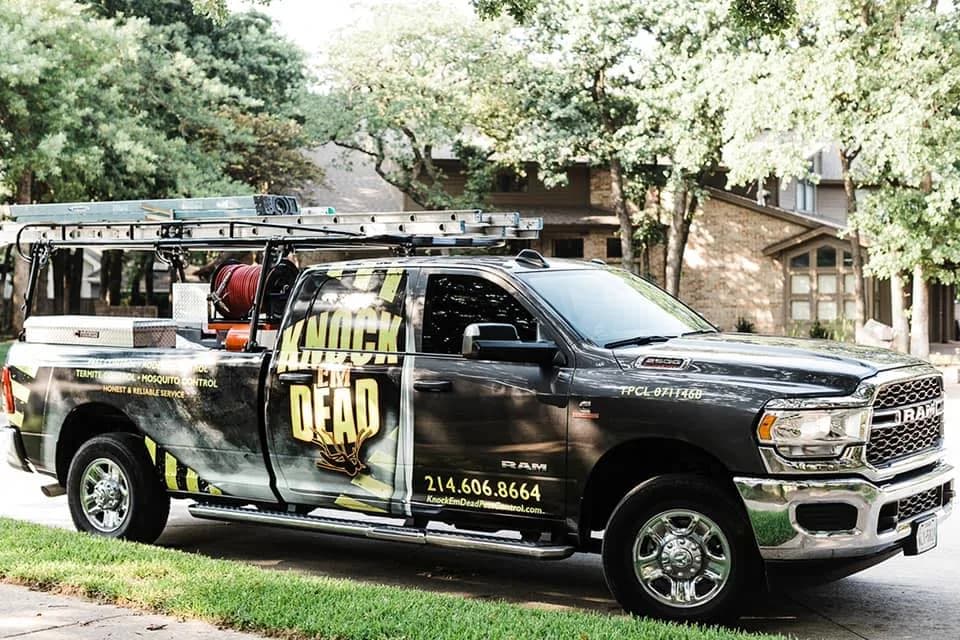
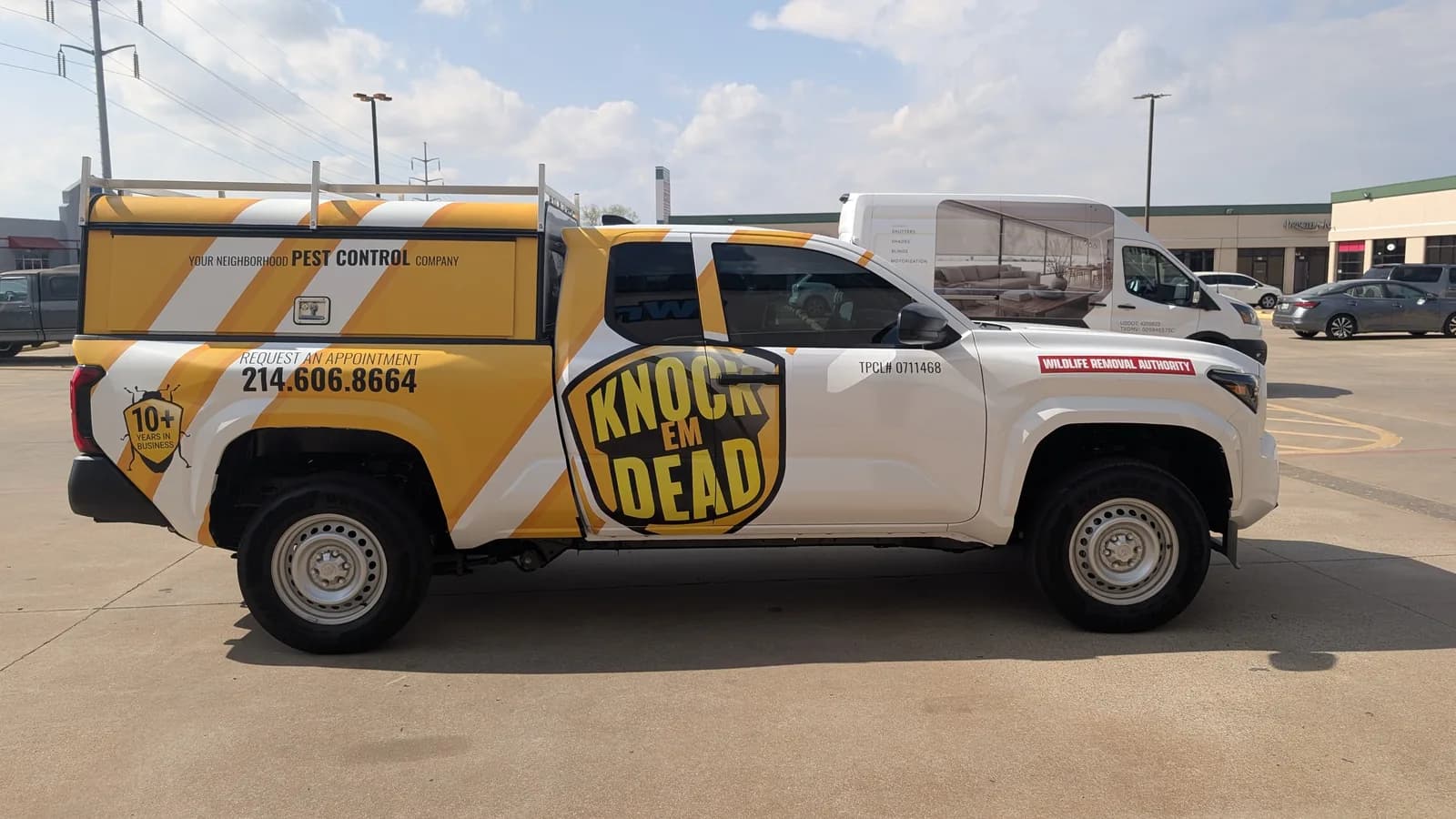
The same pest control company before and after a redesign we did. Run the five element checks against each panel yourself.
The four system checks
A vehicle can pass every element check and the brand can still fail on the road. These four checks inspect how the design performs as a system: on the whole vehicle, across the whole fleet, and into the search results it feeds.
Visual hierarchy and clutter
Count the competing elements on each side of the vehicle. The company name and service category must be the two most legible things on the surface, in that order or together. Every additional element, tagline, badge, bullet list, or photo has to earn its place by not degrading the three-second read. The most common failure is a wrap where everything is treated as equally important, which means nothing is.
Rear-panel communication
The rear of the vehicle gets the longest viewing time of any surface: a trailing driver may look at it for a full stoplight cycle. The rear panel is inspected as its own layout, not an afterthought. It must carry the company name, service category, and phone number at sizes legible from a car length behind, and it must not be sacrificed to a window-covering graphic that adds style but removes information.
Mixed-fleet consistency
A design that passes on a cargo van is re-inspected on every other vehicle type in the fleet: pickups, box trucks, trailers, sedans. The layout adapts to each canvas, but the hierarchy, colors, and identity must read as one company across all of them. A fleet where each vehicle passes individually but the vehicles do not match still fails, because repeated sightings stop compounding into recognition.
Street-to-screen continuity
The last check leaves the parking lot. A driver who sees the truck and searches the company name later must land on a website, Google listing, and reviews that look and sound like the vehicle they saw. If the truck and the search results read as different companies, the impression the fleet built is lost at the handoff. The wrap is inspected against the digital presence it feeds.
How to run the test on your current wrap
- 1
Park the vehicle in an open area with good light. Walk 100 feet away from the side of the vehicle.
- 2
Look at the vehicle for exactly three seconds. Can you read the company name and service category clearly?
- 3
Move to 50 feet. Can you read the brand promise, and the phone number if one is included?
- 4
Photograph the vehicle from a moving car at 35 to 45 MPH. Review the image for how much is legible at that blur level.
- 5
Stand behind the vehicle at 50 feet. Does the rear panel carry the company name, the service category, and the brand promise, with a contact path the name alone does not already provide?
If the wrap fails any step, the design has a legibility problem that is reducing call volume. A free wrap audit from WrapMasters will identify the specific issues and what it would take to correct them.
Common questions
- What is the 45 MPH Test?
- The 45 MPH Test is the operational standard WrapMasters applies to every wrap before production. It asks whether a driver passing at normal suburban road speeds can identify the company name and service category within three seconds of the vehicle entering their field of view. The full standard has nine checks: five element checks covering name, service category, brand promise, contact path, and service area, and four system checks covering hierarchy and clutter, rear-panel communication, mixed-fleet consistency, and street-to-screen continuity.
- Is the 45 MPH Test a scientific or industry standard?
- No, and we say so deliberately. It is WrapMasters' own operational standard: a defined set of viewing conditions and thresholds we developed in practice and apply the same way to every wrap. The 45 MPH speed and three-second window are working conditions drawn from the suburban roads where North Texas service fleets operate, not findings from a published study. We publish the full standard so anyone can run it and judge the results themselves.
- How do I run the 45 MPH visibility test on my current wrap?
- Drive the wrapped vehicle to a parking lot. Stand 100 feet away and look at the vehicle for three seconds. If you can clearly read the company name and service category in that window, the wrap passes the first level of the test. Then stand at 50 feet and check whether the phone number is legible. Finally, photograph the vehicle in motion on a road and review the image for legibility at a realistic blur level. Or submit your wrap for a free audit at WrapMasters and we will evaluate it against the full standard.
- At what distance should a vehicle wrap be readable?
- Company name and service category: 100 feet minimum. Brand promise: legible in the same pass, at 50 feet or better. Phone number or URL, when included: 50 feet minimum with the vehicle stopped or moving slowly. The rear panel, which trailing vehicles see for the longest duration, should meet every threshold because dwell time is highest there.
- Does the 45 MPH test apply to partial wraps?
- Yes. A partial wrap is subject to the same readability requirements as a full wrap. The smaller canvas means fewer elements should be included, and the hierarchy has to be tighter. The most common partial wrap failure is trying to include the same amount of information as a full wrap on a fraction of the surface.
- Does font size in a design file translate directly to vehicle size?
- No, and this is one of the most common production errors. A font size in a design file is relative to the canvas. What matters is the printed inch height of the text on the physical vehicle. An 8-inch company name on a full-size cargo van is the minimum for legibility at 100 feet. Always verify text sizes in physical inches before approving a wrap for production.
- Why does WrapMasters use 45 MPH as the standard, not a higher or lower speed?
- 45 MPH is the typical speed on suburban arterial roads in North Texas, which is where most home service vehicles operate during peak hours. It produces a viewing window of approximately three seconds for a passing driver at 100 feet. At that window, legibility requirements become strict and most decorative design choices have to be subordinated to communication clarity. Highway speeds produce a shorter window that further limits what can be communicated, so designing for 45 MPH is a middle threshold that covers both local and highway exposure.
Don't be a stranger.
See where your current wrap is losing visibility. Upload a side or rear photo and get an instant 45 MPH Test visibility score. Free, no commitment.
New business or no wrap yet? Get started instead, no audit needed.