
HVAC Van Wraps and Truck Wraps
HVAC van wraps and truck wraps in Denton, TX. Wrap production $5,625 to $7,500 for a full van, $4,350 to $5,800 for a pickup; design through the BrandBlueprint, quoted separately. Five HVAC layouts scored against the 45 MPH Test.
An HVAC truck spends two or three hours parked in a driveway on every call, in full view of the neighbors most likely to need the same repair next summer. That is the whole advertising case for wrapping it, and it only works if heating and air and the company name read from across the street. Two separate services get an HVAC truck there. The BrandBlueprint decides what the truck says: what you do, who you are, and one clear way to reach you, legible at 45 MPH and legible parked. Wrap production puts it on the vehicle: 3M cast vinyl, printed in-house, installed at our shop in Denton. Each is quoted on its own.
View us on Google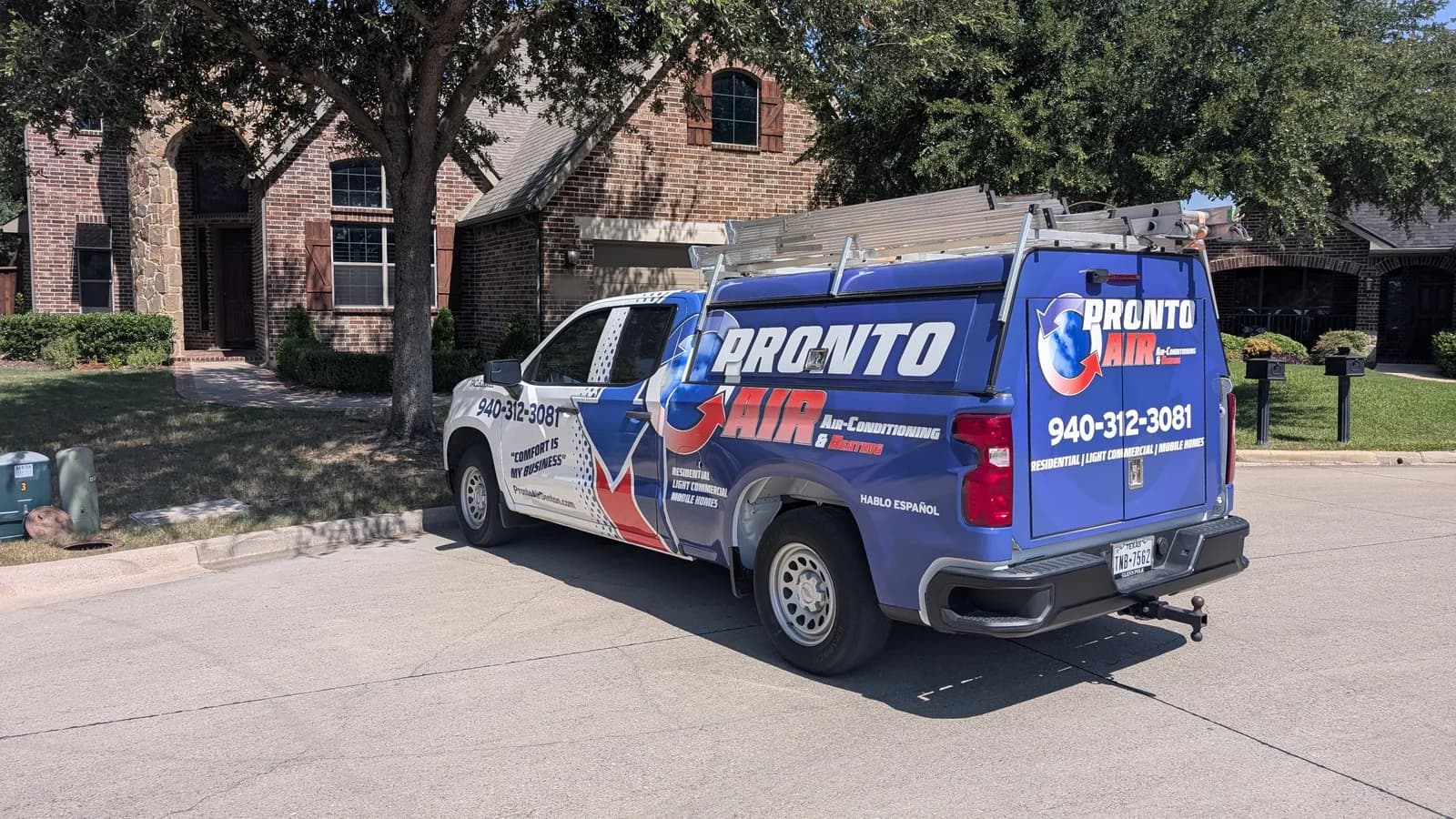
Service-first hierarchy
Heating and air read instantly, not buried under the logo.
Neighborhood recognition
Consistent layout so repeat sightings build familiarity over time.
One clear contact path
Phone number or URL sized to read from across the street.
Fleet-ready design
One system that adapts across vans, pickups, and service trucks.
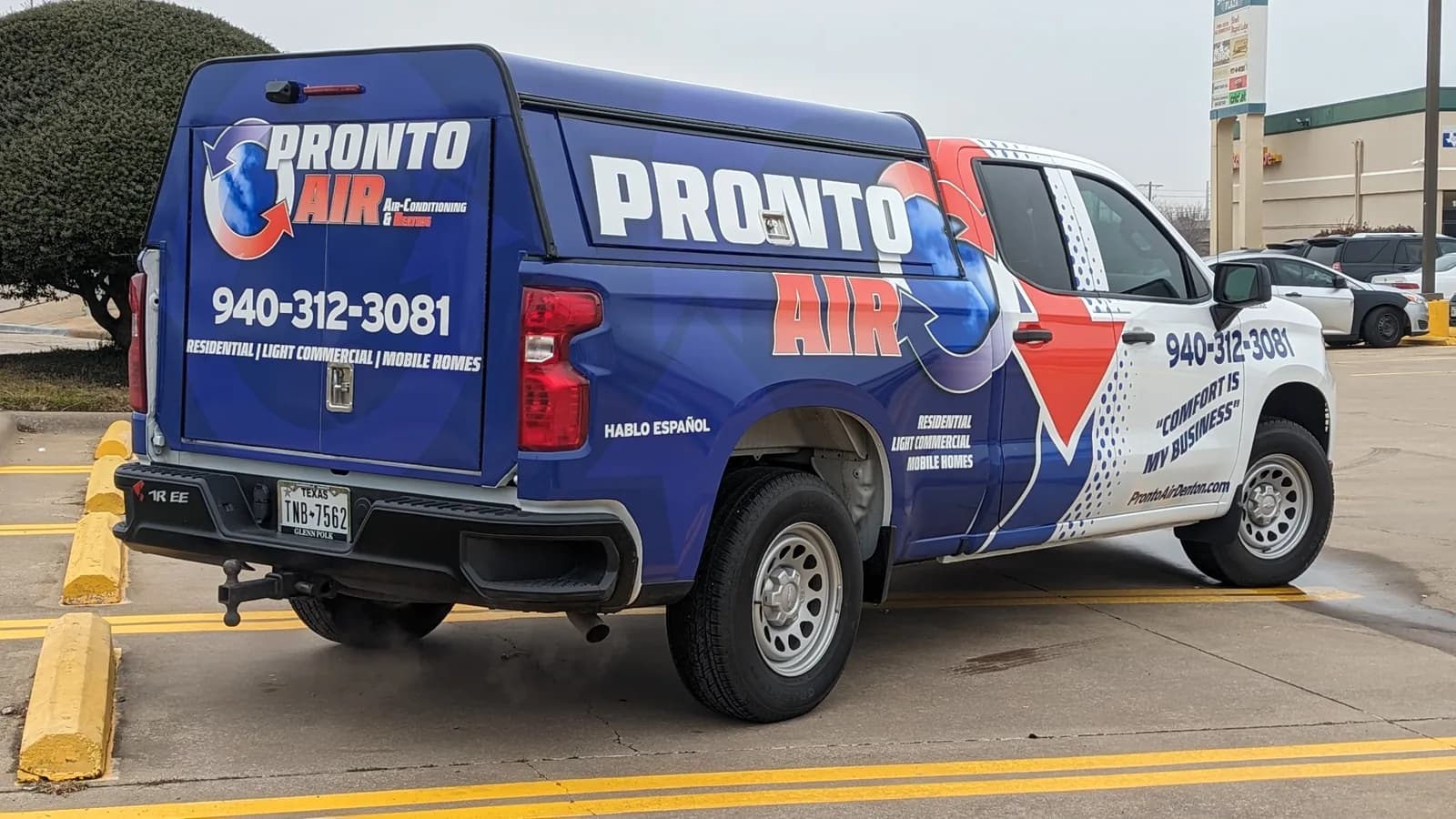
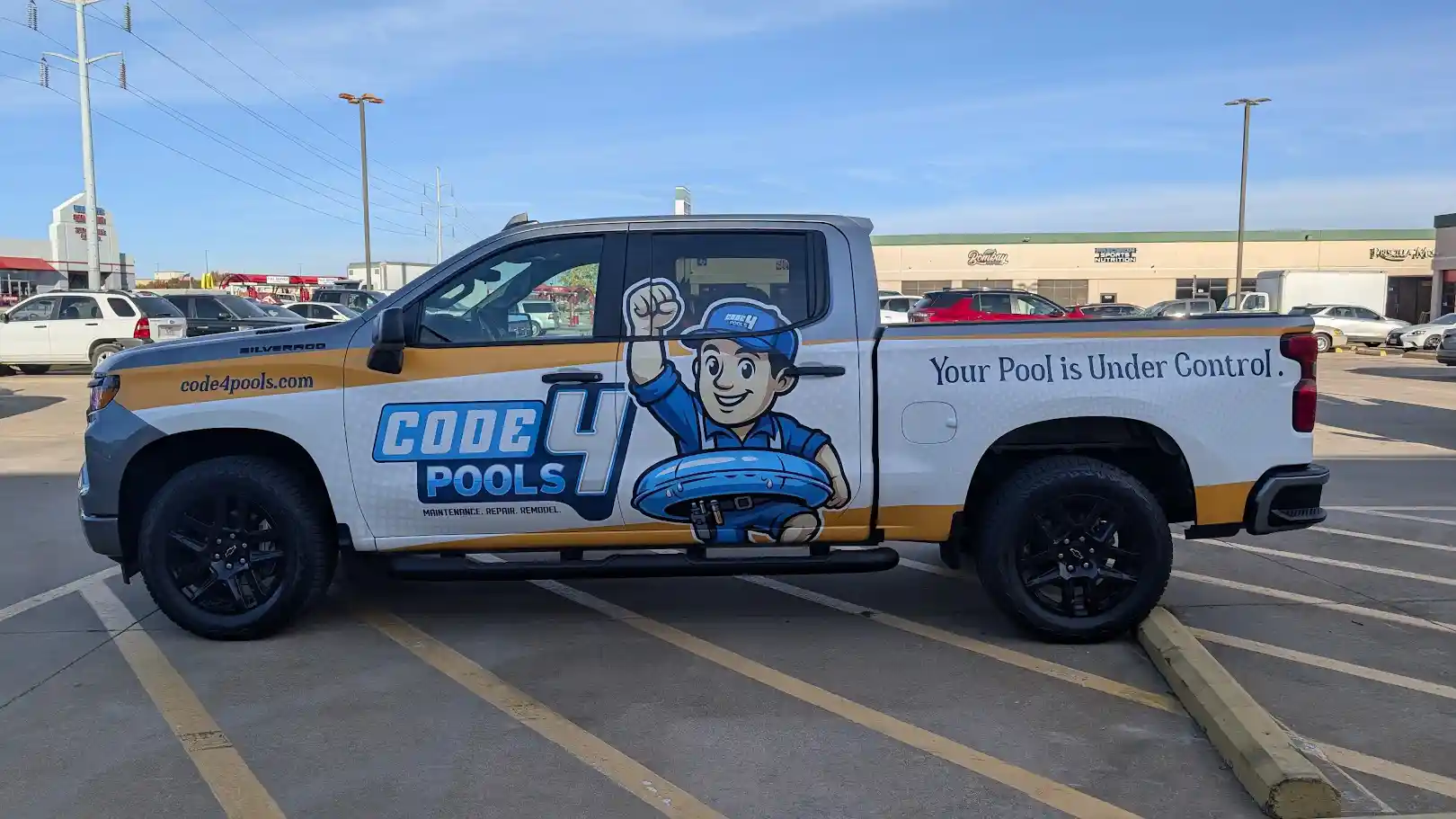
HVAC van wrap designs from our shop
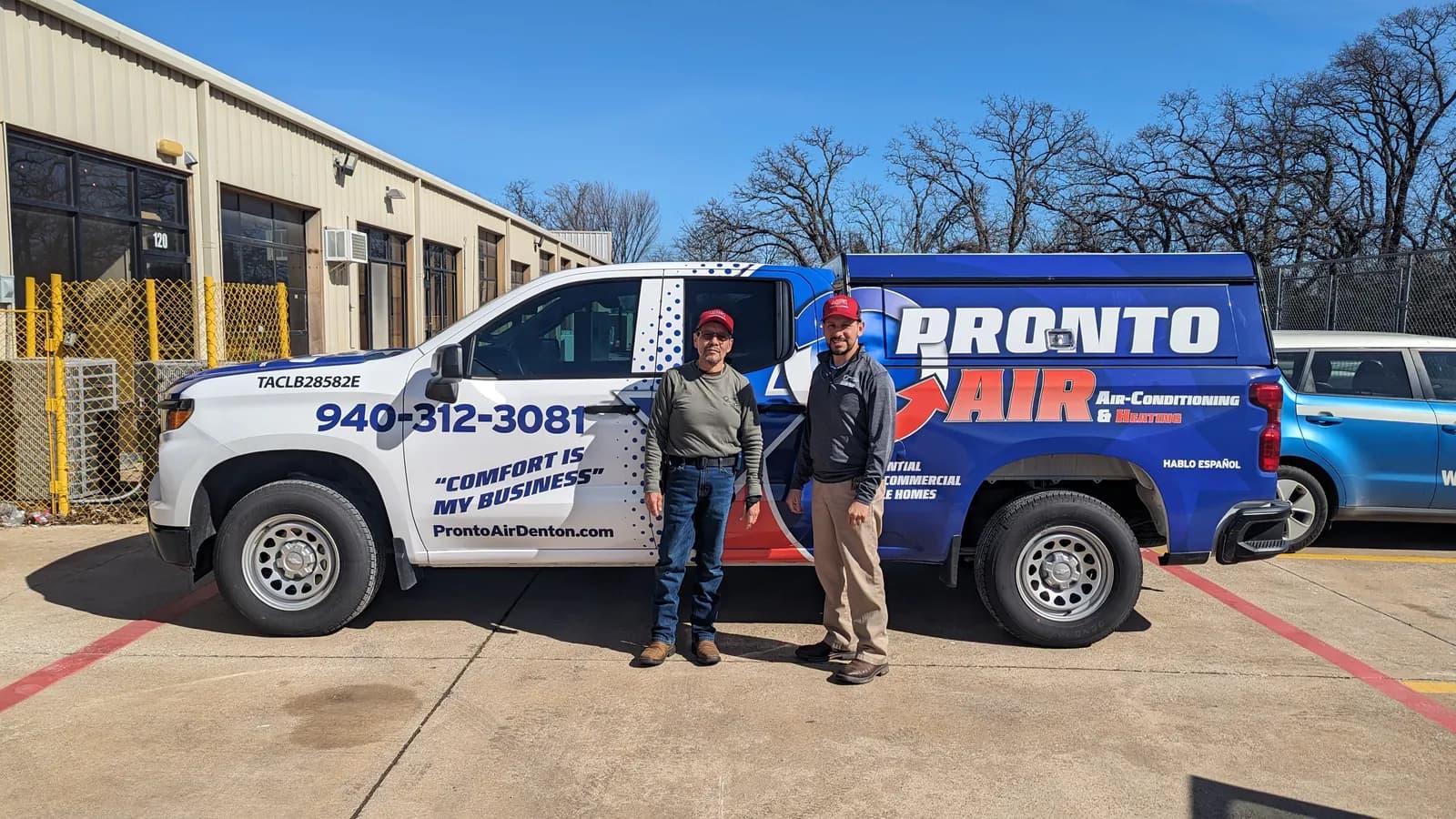
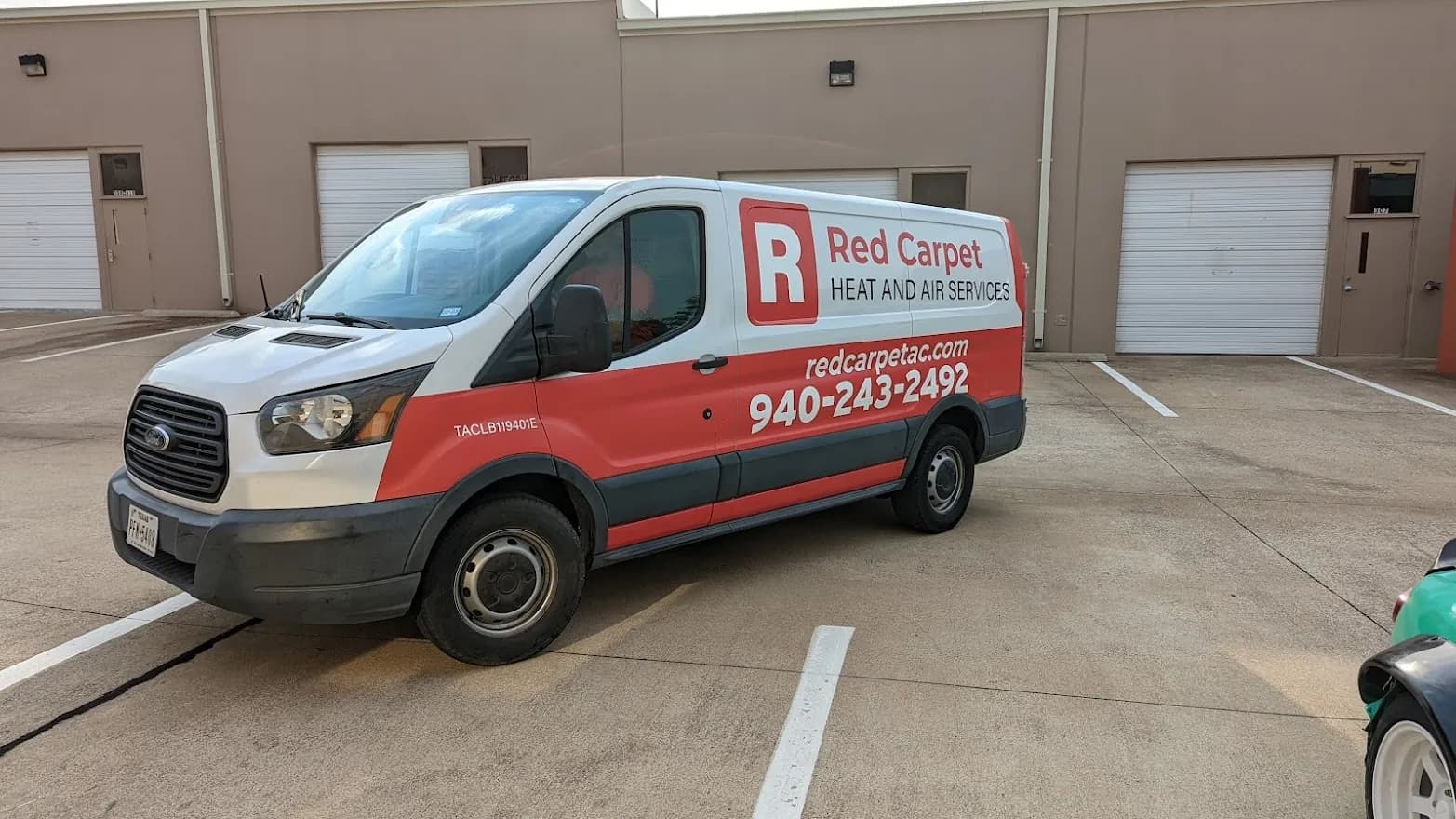
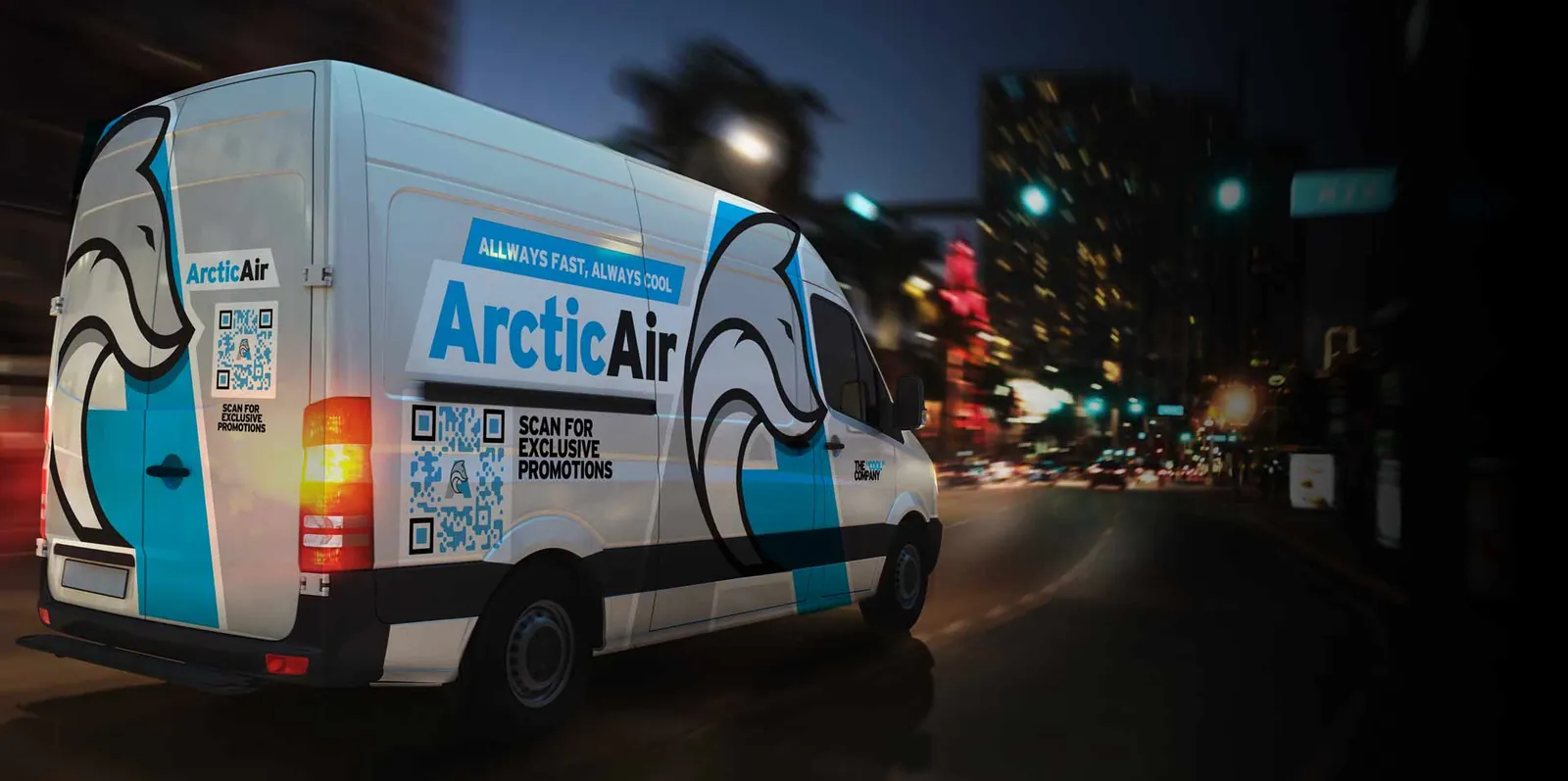
Real HVAC companies, designed in Denton. Tap Before to see what each truck said on the road, with the problems marked, then what it says now.
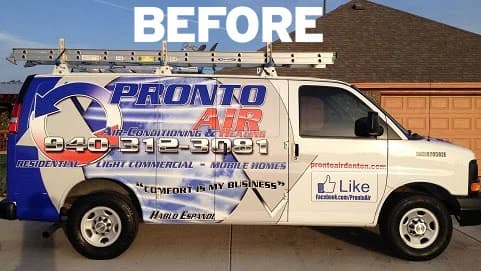
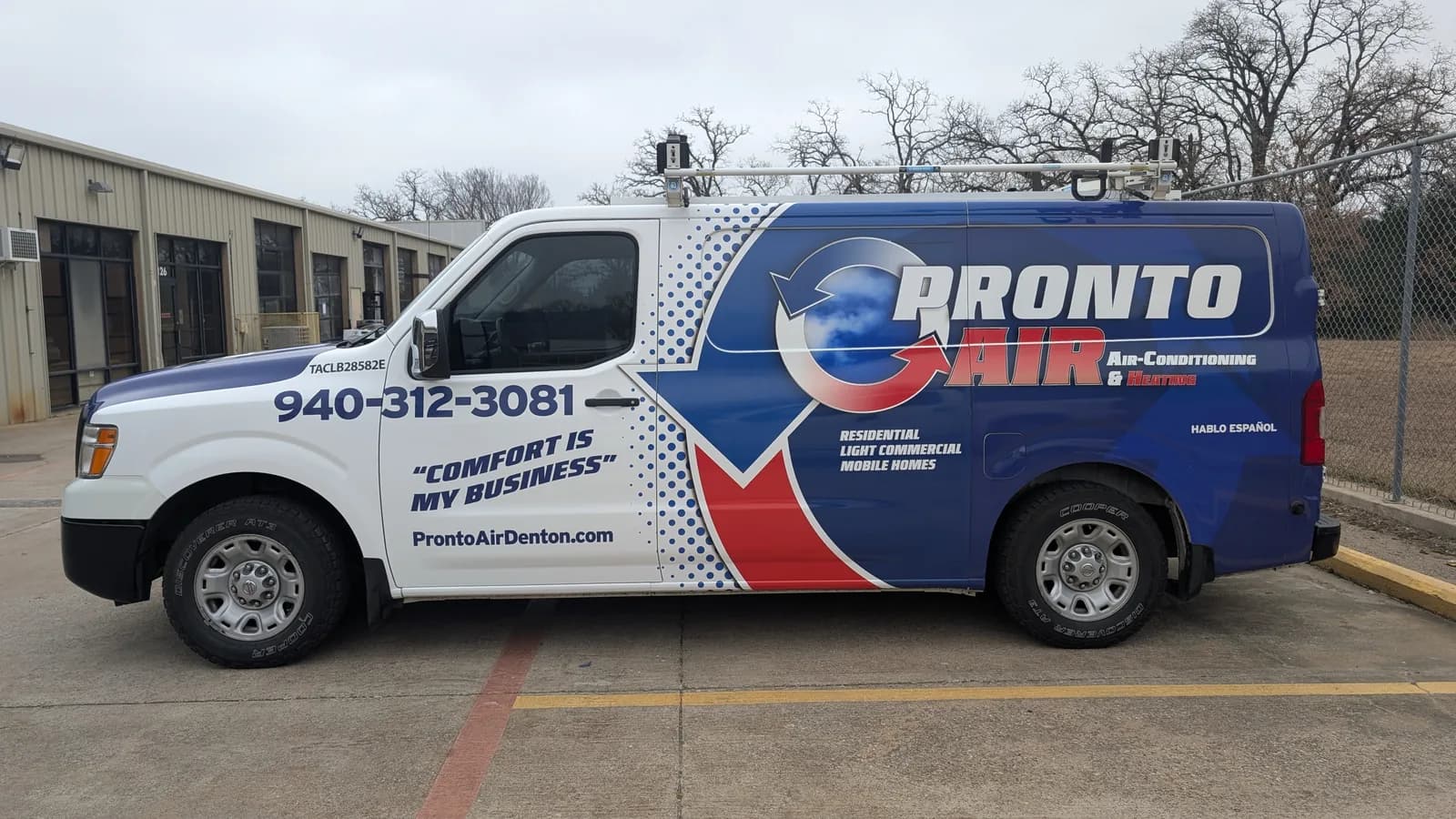
- The name sits on a solid blue field, nothing behind it
- The phone number is dark type on white, sized for the street
- One web address, no social badge
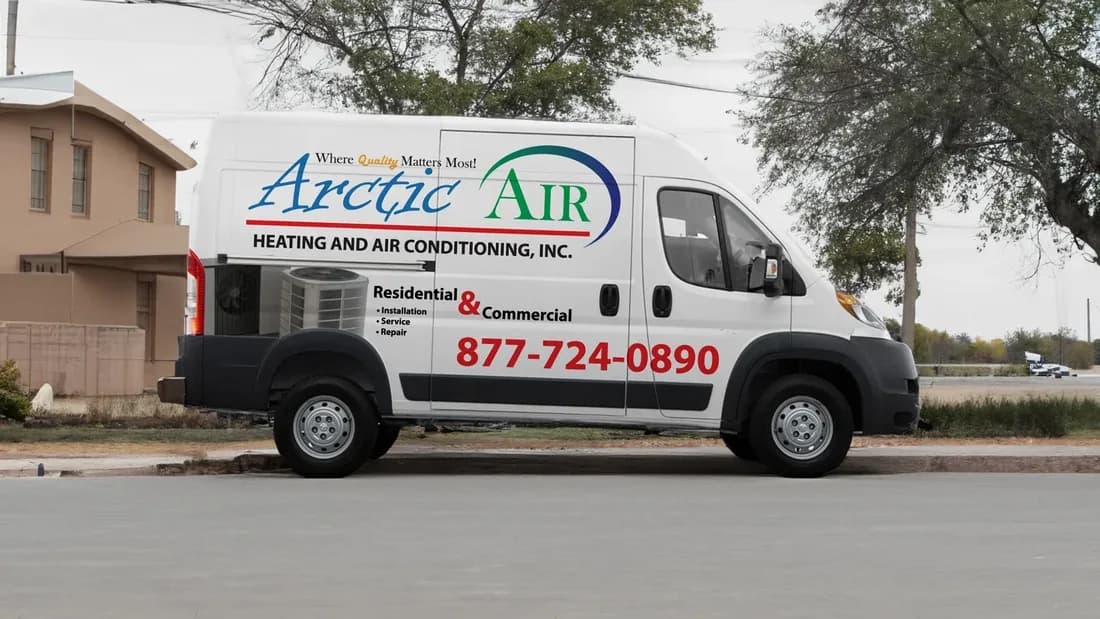
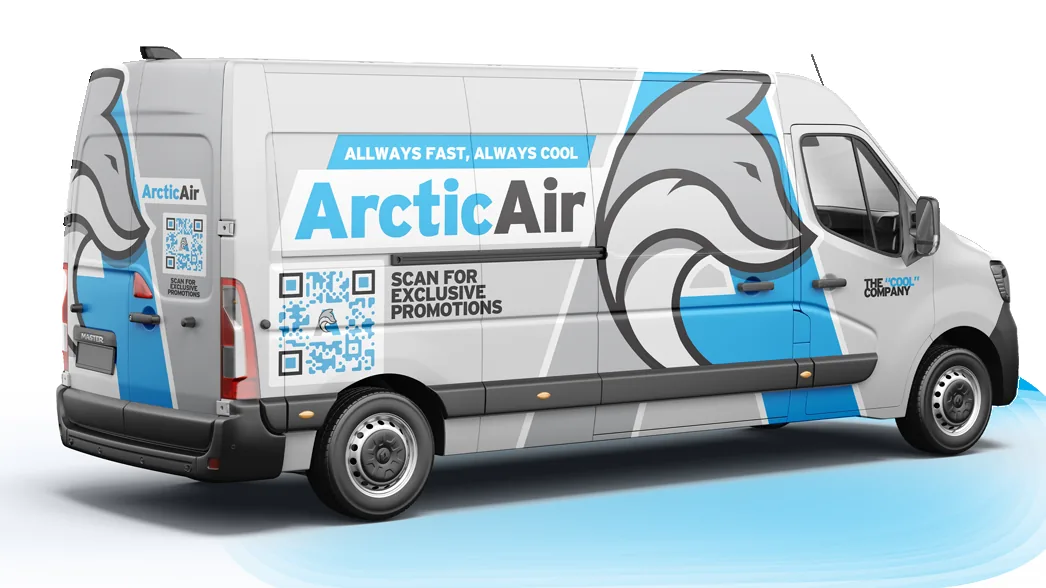
- The name in heavy letters, readable down the block
- A polar bear mascot gives the van a shape people remember
- Big light blue shapes on white, readable in sun or under streetlights
What clients report
4.6x
revenue in two years
The Job Hog rebranded from Platinum Construction. Owner-reported revenue went from $800K to $3.7M.
Read the case study
1 to 4
trucks in eighteen months
Knock Em Dead Pest Control grew from a single wrapped truck to a four-truck fleet.
Read the case study
Both are growth the owners reported after rebranding, not a claim about what a wrap does on its own. The work did that. The brand is what made the market recognize the company doing it.
At a glance
- Vehicle types
- Cargo vans, Sprinter and Transit vans, pickup trucks, service trucks
- Design priority
- Heating and Air readable before the logo. Service category first, then company name
- Two services
- BrandBlueprint for strategy and design ($3,750). Wrap production for print and installation ($15 to $20 per sq ft). Quoted separately
- Material
- 3M cast vinyl with heat-resistant films for Texas roof and hood exposure, printed in-house on HP Latex
- Warranty
- 2-year workmanship and adhesion on every installation
What should be on an HVAC truck wrap?
Every HVAC wrap designed through the BrandBlueprint is checked against the five elements of the 45 MPH Test before it goes to production. Here is what each one means when the vehicle is a Transit, a ProMaster, or an F-250 with a rack.
- Company name. Eight inches minimum on a full-size van, readable from 100 feet. If the name is also the web address, it is doing two jobs and earns the space.
- Service category. Heating and Air or AC Repair at nearly the same weight as the name. This is the element HVAC wraps most often bury under a logo, and it is the one a homeowner with a dead system is scanning for.
- Brand promise. One breath long, specific, and about how you operate. Same-Day AC Repair passes. Quality You Can Trust does not; nobody has ever called a number because of it.
- Contact path. Phone or URL, four inches minimum on the rear doors, because the rear is what the car behind you at the light actually reads. If your name is your URL, the name covers it.
- Service area. Supporting element, one to two inches. Serving Denton County is enough. A list of eleven cities is a capability list, and it fails.
The most common HVAC wrap mistake
The capability list: Heating, Cooling, Plumbing, Electrical and More. A list describes what you sell. A promise commits to how you operate. Only one of them makes the phone ring. Put the category you want to be known for on the truck and the full list on the website.
Five HVAC van wrap ideas, scored against the 45 MPH Test
These are layout systems, not decorations. Each is described the way we would present it in a BrandBlueprint, with the result it earns on a standard cargo van.
- The Service Block. Company name across the upper third of the side panel, Heating and Air in a solid color block at the same height beneath it, phone on the rear doors only. Nothing else on the sides. Passes all five elements.
- Two-Tone Split. Cab and hood in the brand's dark color, cargo box in the light color, name and category set where the two meet. Reads as one shape from 100 feet and costs less to produce than full-coverage print. Passes all five.
- The Promise Panel. Rear doors carry the brand promise as the largest element (Fixed Today or It's Free), name and phone beneath it. Sides carry name and category only. Built for the vehicle behind you in traffic. Passes all five.
- Emergency Stripe. Reflective band at bumper height carrying 24/7 Emergency AC on both sides and the rear, so the promise reads at night on a service call. Name and category above in standard print. Passes all five, plus night visibility.
- The Mural. Full-color scene (snowflakes, sun, a cutaway of a compressor) with the name integrated into the artwork. This is the layout most HVAC owners ask for first and the one that fails most often, because the name and category lose the fight with the picture. Fails name and category legibility.
Modern HVAC van wraps: what has changed
Ten years ago an HVAC wrap was a phone number and a snowflake. Three things have changed. Homeowners now find you on their phone after they see the truck, so the name has to be spellable from memory and the URL has to match it. Fleets are mixed, so the design has to hold across a ProMaster, a Transit Connect, and a pickup with a ladder rack without redrawing it each time. And roof-mounted equipment and Texas summers punish cheap film, so production uses 3M cast vinyl with heat-resistant films on the roof and hood. Reflective elements for 24/7 fleets are standard, not an upgrade.
The most common vehicles we wrap for HVAC companies are cargo vans, Sprinter vans, and full-size pickup trucks. Vans give maximum surface area for the service category, company name, and phone number. Truck wraps are scaled to the cab and box, which are viewed at shorter range and at angles, so the layout is drawn differently than a van. Every element is sized and positioned for the actual vehicle template, not a generic one.
Built for HVAC fleets and Texas seasons
- Heat-resistant films rated for cab-top equipment and condenser loads.
- Reflective and night-visibility options for 24/7 service fleets.
- Quick-turn additions when you bring on new techs mid-season: the template already exists, so a new van is a production job, not a design job.
- One consistent look from the first van to the newest.
One promise on six vans: an example
This is an illustration of the method, not a client result. Picture an HVAC fleet that says heating and cooling in six different ways on six different vans. The BrandBlueprint gives it one promise and one layout system. Production can then run in phases, so no more than one van is off the road at a time. When it is finished, every van reads the same from 100 feet, and the newest one matches the first.
“Chris is an expert at taking ideas and concepts and turning them into graphics that really tell a story. He consistently brought it to life better than I imagined. He truly understands how to communicate a message visually. He is a joy to work with!”
Lynn Clayton Clark
Recent work
From the blog
Related reading
Commercial Car Wraps
HVAC Vehicle Wrap Redesign: A Worked Example
A made-up HVAC company, a van that fails the 45 MPH Test, and the fixes that matter: brand consistency, clear messaging, quality visuals and where the information goes. An illustration of the method, not a client story.
Read moreVehicle Wraps
Everything You Need to Know About Vehicle Wraps
If you've been wondering how vehicle wraps, truck wraps, or commercial wraps can help grow your business, you're in the right place.
Read moreVehicle Wrap Design
Why the Best-Performing Vehicle Wraps Aren't the Most Creative
The wraps that produce the best return aren't the most creative ones. They're the clearest ones. Here's why clarity beats creativity at 45 MPH.
Read moreHVAC Van Wraps and Truck Wraps FAQ
- What should an HVAC van wrap say?
- Your company name, heating and air (or the category you actually want calls for), one brand promise, and a phone number or web address. In that order of size. Anything beyond those five elements is competing with them.
- Should the wrap list every service we offer?
- No. A wrap is read in about three seconds at speed. A list of eight services reads as noise, and the homeowner who needs AC repair does not find it faster because duct cleaning is also on the truck. Put the category you want to be known for on the vehicle and the full list on the website.
- Do you design the HVAC wrap or do we bring our own artwork?
- Either. Design is its own engagement: the BrandBlueprint ($3,750) sets the name, category, promise, and layout system, and it is quoted separately from print and installation on every wrap we design. If you already have finished artwork, we can print and install it at the standard per-square-foot rate; the design stays yours, and the 45 MPH Test standard does not apply to work we did not design.
- What does an HVAC van wrap cost?
- Wrap production is $15 to $20 per square foot. A full wrap on a Transit, Sprinter, or Express cargo van runs $5,625 to $7,500 at WrapMasters, including 3M cast vinyl, full-color print, installation, and a 2-year workmanship warranty. HVAC pickup truck wraps run $4,350 to $5,800 for a full wrap. Partial wraps covering the sides and rear panels start from $1,500. Design, if we do it, is the BrandBlueprint at $3,750, a separate service quoted on its own. See truck, van, and box truck wrap pricing.
- How does a vehicle wrap help an HVAC business get more calls?
- When your truck is parked in a driveway for several hours, every neighbor who drives by sees the company name and service category. Repeated sightings in the same neighborhoods build recognition over time. When a homeowner's system fails, they are more likely to call a company they have already seen working nearby.
- What is the difference between an HVAC van wrap and a truck wrap?
- A van wrap covers more total surface area and gives more room for the service category, logo, and contact number at reading distance from the curb. A truck wrap is sized to the cab and bed, which are viewed at shorter range. Both accomplish the same thing: every neighborhood your crew works in sees your company name and what you do.
- Will an HVAC wrap hold up to rooftop equipment and Texas heat?
- Yes. We use heat-resistant 3M films rated for cab-top equipment and condenser loads. A professionally installed wrap lasts 5 to 7 years, and up to 10 when the vehicle is garage-kept.
- Can you wrap a mixed HVAC fleet of vans and trucks?
- Yes. The BrandBlueprint builds one design system with a template for each vehicle type you run, so cargo vans, Sprinter vans, pickups, and service trucks all read as the same company. Adding a vehicle mid-season is a production job from the existing template.
- How long will an HVAC van wrap last?
- A professionally installed 3M cast vinyl wrap lasts 5 to 7 years under normal outdoor exposure. Garage-kept vehicles often reach 10 years. WrapMasters backs every installation with a 2-year workmanship warranty.
- Is it cheaper to wrap or paint an HVAC van?
- A commercial repaint runs $3,000 to $6,000 and leaves you with a plain-color van. A full wrap in that same range gives you printed company name, service category, and phone number, plus a removable finish that protects the factory paint. For HVAC fleets where every parked van is visible in a customer's neighborhood, wrapping delivers more per dollar than painting.
- Can my wrapped HVAC van go through a carwash?
- Touchless carwashes are safe. Automatic brush carwashes are not recommended because the bristles can lift wrap edges at seams and around mirrors. Hand washing with mild soap works best. Avoid directing a pressure washer at seams and door edges.
Don't be a stranger.
See where your current wrap is losing visibility. Upload a side or rear photo and get an instant 45 MPH Test visibility score. Free, no commitment.
New business or no wrap yet? Get started instead, no audit needed.