
Commercial Wrap Audit
What to check on every fleet vehicle to confirm the wrap is doing its job.
Most fleet wraps are evaluated once, at approval, before they go to print. After installation, the vehicles go to work and the wraps are rarely looked at critically until something visibly wrong forces a conversation.
A commercial wrap audit is a structured review that happens after the wraps are in service. It covers three things: whether the design still communicates effectively at road speed, whether the vinyl is adhering and aging as it should, and whether all vehicles in the fleet look like the same company.
The checklist below is the same evaluation framework WrapMasters uses for fleet audits. It can be run independently on each vehicle in the fleet.
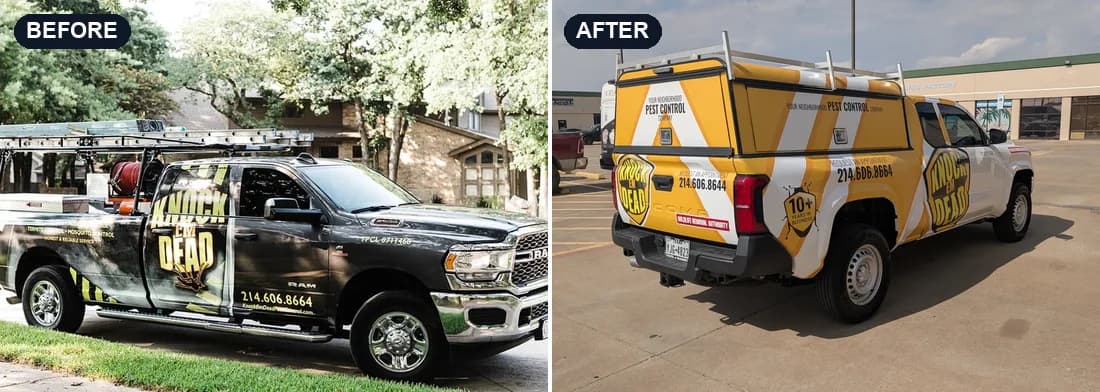
Design legibility
Evaluated from the actual viewing distance and speed a passing driver experiences, not from a parking lot at close range.
Company name at 100 feet
Pass
Clearly readable from 100 feet on both the driver and passenger sides.
Fail
Requires stopping or slowing significantly to read. Obscured by a logo or tagline.
Service category at 100 feet
Pass
"Plumbing," "HVAC," "Roofing," or equivalent visible at 100 feet independent of the company name.
Fail
Missing entirely, or subordinated to a tagline that does not name the trade.
Phone number at 50 feet
Pass
Full phone number readable from 50 feet without moving closer.
Fail
Type too small, placed against a low-contrast background, or absent from the rear panel.
Rear panel content
Pass
Company name and phone number present on the rear panel at sufficient size for a trailing vehicle.
Fail
Rear panel shows only a logo, website, or is blank.
Contact path legibility
Pass
Phone number and website URL both included and readable at 50 feet.
Fail
One or both missing. URL too small or formatted in a way that requires stopping to copy.
Production condition
Physical condition of the wrap material, adhesion, and surface appearance after time in service.
Edge adhesion
Pass
All edges fully bonded to the vehicle surface, including around door handles, mirrors, and moldings.
Fail
Visible lifting at any edge, corner, or panel seam.
Surface condition
Pass
No bubbles, wrinkles, tears, or punctures visible across any panel.
Fail
Any bubble or wrinkle larger than 1 cm diameter. Any tear or puncture in the vinyl surface.
Color consistency
Pass
Color appears uniform across all panels. No visible fade differential between panels.
Fail
Noticeable color shift between panels, or visible UV fade compared to unexposed areas.
Overlaminate condition
Pass
Laminate surface is clear and intact with no delamination or haze.
Fail
Visible haze, delamination, or peeling of the overlaminate layer.
Overall lifespan estimate
Pass
Wrap is within the expected lifespan for the material specification (typically 5 to 7 years for cast vinyl).
Fail
Wrap is beyond expected lifespan or showing accelerated aging signs due to material or installation issues.
Brand consistency
Whether all vehicles in the fleet project the same brand identity, and whether the fleet identity matches the company's other touchpoints.
Color system across fleet
Pass
All vehicles use the same primary and secondary colors. No variation in hue or saturation between vehicles.
Fail
Color differences visible when vehicles are parked side by side. Different color versions in use across the fleet.
Logo treatment across fleet
Pass
Logo appears in the same position, size ratio, and version on all vehicles.
Fail
Different logo versions, sizes, or placements across the fleet.
Type hierarchy across fleet
Pass
Company name, service category, and phone number appear in the same relative sizes and positions across all vehicle types.
Fail
Different font choices, sizes, or layouts across the fleet.
Consistency with other brand touchpoints
Pass
Fleet livery matches the company website, uniforms, signage, and proposal/invoice templates in color and visual identity.
Fail
Fleet looks materially different from other brand touchpoints. A prospect who searches the company name after seeing the truck lands on a page that looks unrelated.
What to do with your audit results
Group your findings by urgency. Production failures, edge lifting, bubbling, cracking, are the most time-sensitive because they worsen and spread if not addressed. A small edge lift in January becomes a full panel issue by summer.
Design legibility failures are the highest-impact category for lead generation. A vehicle that fails the 100-foot company name check is running advertising that does not convert. Correcting the design or adding a spot overlay can recover that performance without a full re-wrap in some cases.
Brand consistency failures are cumulative. One inconsistent vehicle out of five is a minor issue. Three out of five undermines the entire fleet's ability to build recognition. If consistency is a significant problem, a coordinated re-wrap plan with a defined timeline is more effective than addressing vehicles one at a time.
Common questions
- What is a commercial wrap audit?
- A commercial wrap audit is a structured evaluation of an existing fleet's vehicle wraps across three areas: design legibility (can a passing driver read it at speed?), production condition (is the vinyl adhering and aging correctly?), and brand consistency (do all vehicles look like the same company?). The audit produces a specific list of issues and recommended actions for each vehicle.
- How often should I audit my fleet wraps?
- Once per year is a reasonable baseline. More frequently if the fleet operates in high-UV conditions, vehicles are washed daily, or you have recently added vehicles that need to match the existing fleet. The audit should also happen any time you rebrand or update your visual identity, to confirm the fleet reflects the new brand.
- Can I run a wrap audit myself?
- The design legibility and brand consistency portions of the audit can be run without specialized equipment, they require distance evaluation and side-by-side comparison. The production condition portion benefits from knowing what early failure modes look like for different material types, which requires some experience. A professional audit from WrapMasters covers all three areas and includes specific recommendations for each finding.
- What happens if my wrap fails the audit?
- The outcome depends on what failed and how severely. A design legibility issue may be addressable with a spot correction or a partial re-wrap of specific panels. A production failure at specific edges can sometimes be repaired without full replacement. A brand consistency failure across the fleet typically requires a coordinated redesign and re-wrap to resolve completely. The audit report identifies which vehicles need immediate action and which can wait.
- How much does a wrap audit cost?
- WrapMasters offers a free wrap audit for North Texas service companies. Bring your vehicle to our shop in Denton or send photos of each panel, and we will evaluate the design against our 45 MPH visibility standard and assess the production condition. The audit comes with a written report and specific recommendations.
Don't be a stranger.
See where your current wrap is losing visibility. Upload a side or rear photo and get an instant 45 MPH Test visibility score. Free, no commitment.
New business or no wrap yet? Get started instead, no audit needed.