
Why Most Vehicle Wraps Fail to Generate Leads
They were designed to look good in a parking lot, not to work at 45 MPH.
A vehicle wrap is one of the most cost-effective forms of advertising available to a local service business. The math is straightforward: a single well-designed wrap on a truck that drives 20,000 miles per year generates millions of impressions over its lifespan at a cost per impression far below any digital channel.
Most wraps do not deliver on that potential. Not because vehicle wrap advertising does not work, but because most wraps were never designed to perform under the actual conditions a service vehicle operates in: moving at 35 to 65 MPH, viewed from a distance of 50 to 150 feet, in three seconds or less.
The seven failure patterns below account for the majority of underperforming wraps we audit. Each one is avoidable when the design process starts with the right question: not "does this look good?" but "can a driver read this before the light changes?"
The seven most common wrap failures
These are not design opinions. Each one measurably reduces the number of calls a wrapped vehicle generates.
The company name is not the largest element
Many wraps lead with a logo mark or a tagline and treat the company name as a secondary element. At traffic speed, a driver has roughly three seconds to register what they see. If the most legible element is not the company name, the opportunity is gone. The name should dominate the layout.
The service category is missing or buried
A driver who has never heard of your company does not care about your name until they know what you do. "Plumbing," "HVAC," "Pest Control," "Roofing", these category labels are the most important words on the vehicle for a first-time viewer, and they are frequently left off entirely or printed at a size that cannot be read from a moving car.
Too much information
A wrap is not a business card. Service lists, mission statements, social media handles, and slogans compete with the information that actually generates calls. Every line of copy added to a wrap reduces the legibility of everything else. The most effective wraps carry three to five elements: name, category, phone number, website, and a simple call to action.
Wrong font choices
Script fonts, condensed fonts, and thin-weight fonts read well on a screen and fail on a vehicle moving at 45 MPH. Legibility at speed requires clean, open letterforms with generous spacing. Decorative fonts on a service category or phone number are among the most common reasons wraps fail the visibility test.
Low contrast between text and background
Dark text on a dark background, or a busy photographic background behind key copy, collapses at distance and in poor lighting. The phone number and company name need a contrast ratio high enough to read clearly in bright sun, overcast conditions, and at dusk. This is the most common failure on wraps where the designer prioritized visual complexity over readability.
The back of the vehicle is ignored
The rear of a service vehicle is the most-viewed surface in traffic because other drivers spend more time behind it than beside it. Most wraps treat the rear as secondary, a logo, a website URL, or nothing at all. A wrap that does not use the rear panel to communicate company name and phone number is leaving the highest-exposure surface unused.
The wrap was designed for photos, not for traffic
A wrap that photographs well in a studio or a flat parking lot does not necessarily work on a road. Renders, mockups, and static photos do not replicate the motion blur, varying light conditions, and short viewing window of real-world traffic. Wraps designed primarily to win design awards or impress at trade shows often underperform as daily advertising.
The failure patterns on one vehicle
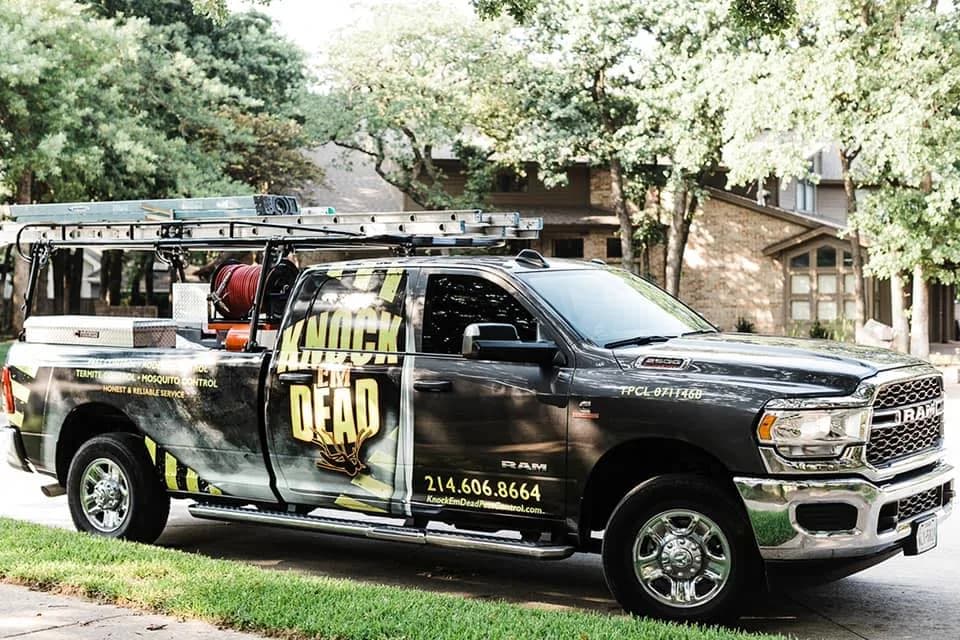
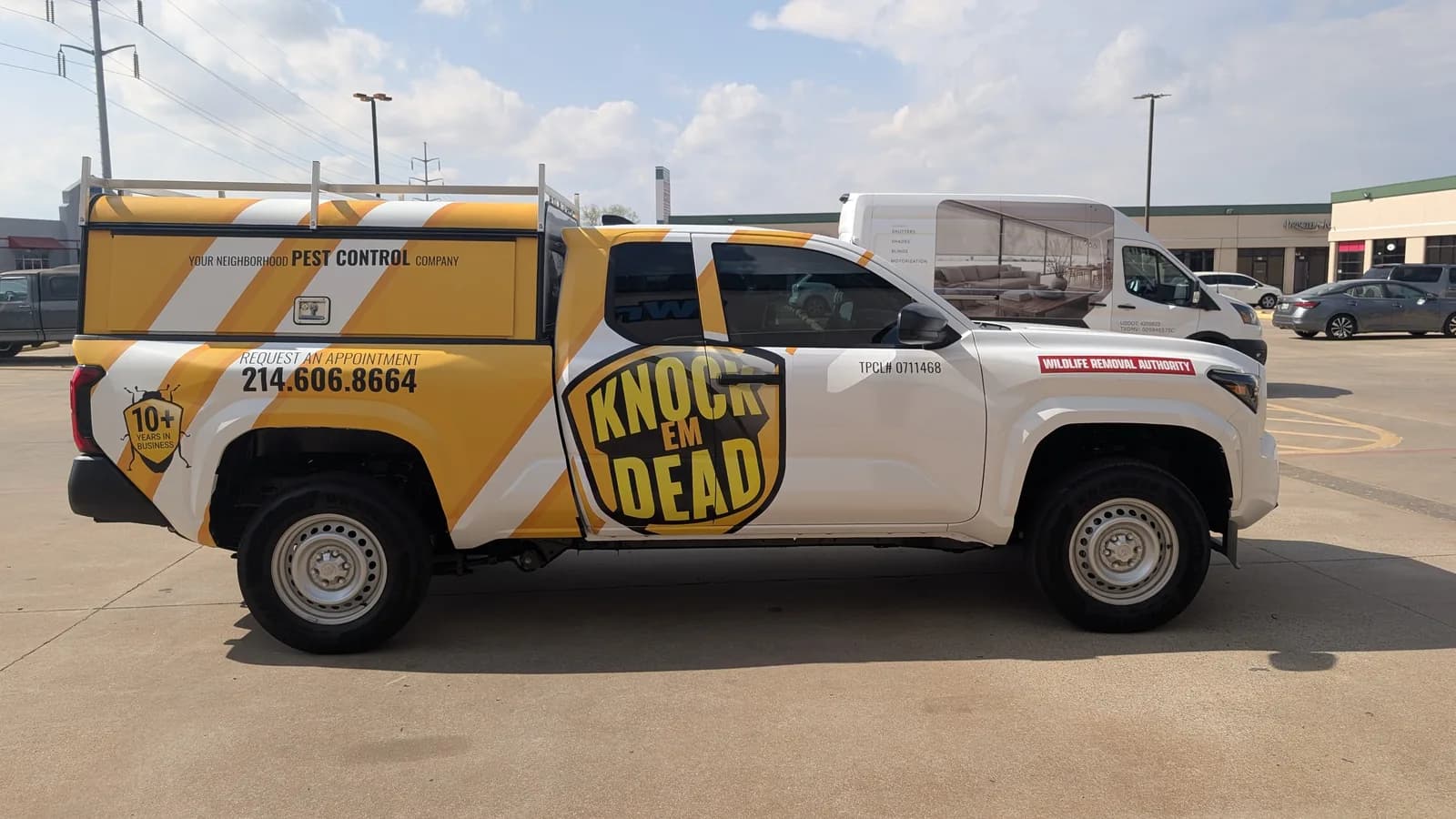
The same pest control company before and after the redesign we did. Several of the seven patterns are visible in the first photo, and the second fixes the ones that cost the read.
What a working wrap actually does
A wrap that generates leads consistently does four things in three seconds or less: it tells a passing driver who you are, what you do, how to reach you, and that you are a professional company worth trusting with a call.
That is not a creative brief. It is an engineering constraint. The design has to solve for legibility at speed, contrast in variable lighting, and recall after the vehicle has passed. Everything else, color choices, illustration style, background treatment, is subordinate to those requirements.
WrapMasters has operated as a branding agency since 2001 and has wrapped fleets since 2020. The 45 MPH Test is the standard we developed from two decades of evaluating what works on North Texas roads, not what wins graphic design competitions. Every wrap we produce is measured against it before it goes to print.
Common questions
- How do I know if my current wrap is generating leads?
- Ask every new customer how they found you. If 'saw your truck' is rarely or never the answer, the wrap is not converting at-speed views into inquiries. A free wrap audit from WrapMasters evaluates the design against the 45 MPH visibility standard and identifies specific readability issues.
- What is the 45 MPH visibility standard?
- The 45 MPH visibility standard is the threshold WrapMasters uses to evaluate wrap designs. It asks whether a driver passing at highway speed can identify the company name and service category within three seconds of the vehicle entering their field of view. Most wrap designs fail this test because they were never evaluated against it.
- Can a bad wrap be fixed without replacing it entirely?
- Sometimes. If the underlying design has correct hierarchy but a specific element is undersized or low-contrast, a spot correction or an added panel can improve readability without a full replacement. In most cases, however, a wrap designed without the visibility standard in mind has structural layout problems that require a redesign.
- Does the vehicle type affect how readable a wrap is?
- Yes. A cargo van provides a large flat canvas that rewards strong hierarchy and large type. A pickup truck has more surface interruptions, door handles, wheel wells, mirrors, that break up the layout. A sedan has less lateral surface. The design approach has to match the canvas, and many wrap shops apply the same design template regardless of vehicle type.
- How many leads should a properly designed fleet wrap generate?
- There is no honest universal number, and we are skeptical of the daily-impression statistics the wrap industry repeats, because they lack a published methodology. What a well-designed wrap in a service-dense market like DFW should produce is consistent inbound inquiries attributable to the vehicle, the kind that start with 'I saw your truck.' The rate depends on design quality, service area density, and daily miles driven. Tracking it means asking every new customer how they heard about you.
Don't be a stranger.
See where your current wrap is losing visibility. Upload a side or rear photo and get an instant 45 MPH Test visibility score. Free, no commitment.
New business or no wrap yet? Get started instead, no audit needed.