
The Service Trade Brand Guide.
A practical walkthrough of what makes a wrap easy to recognize and remember, from layout and hierarchy to materials and common mistakes.
The 3-second rule
When a potential customer sees your vehicle on the road, they have approximately three seconds to read it. That is the same window engineers use when designing highway signage, and it is the standard every wrap we build is held to.
In those three seconds, a driver needs to register three things: who you are, what you do, and how to reach you. If any one of those requires effort to find, the wrap has failed at its primary job.
Most commercial wraps fail this test. Not because the design is unattractive, but because they were designed for a business card, not a moving vehicle. The hierarchy that works at a desk is not the hierarchy that works at 45 MPH.
The hierarchy that works at traffic speed
Every element on a vehicle competes for the same three seconds of attention. Priority determines what gets read and what gets ignored.
Company name
The largest element on the vehicle. If a passing driver can read your name, they can look you up. This is the single most important element on any wrap.
Service category
"Heating & Cooling," "Plumbing," "Pest Control." The category often matters more than the logo. A driver who has never heard of your company needs to know what you do before they care who you are.
Phone number
Minimum 4 inches tall on a full-size van. Use a local number, not a toll-free vanity number that is difficult to recall after a glance.
Everything else
Taglines, certifications, social handles, and service bullet points are visual noise at traffic speed. They belong on your website, not your van.
Contrast beats brand purity
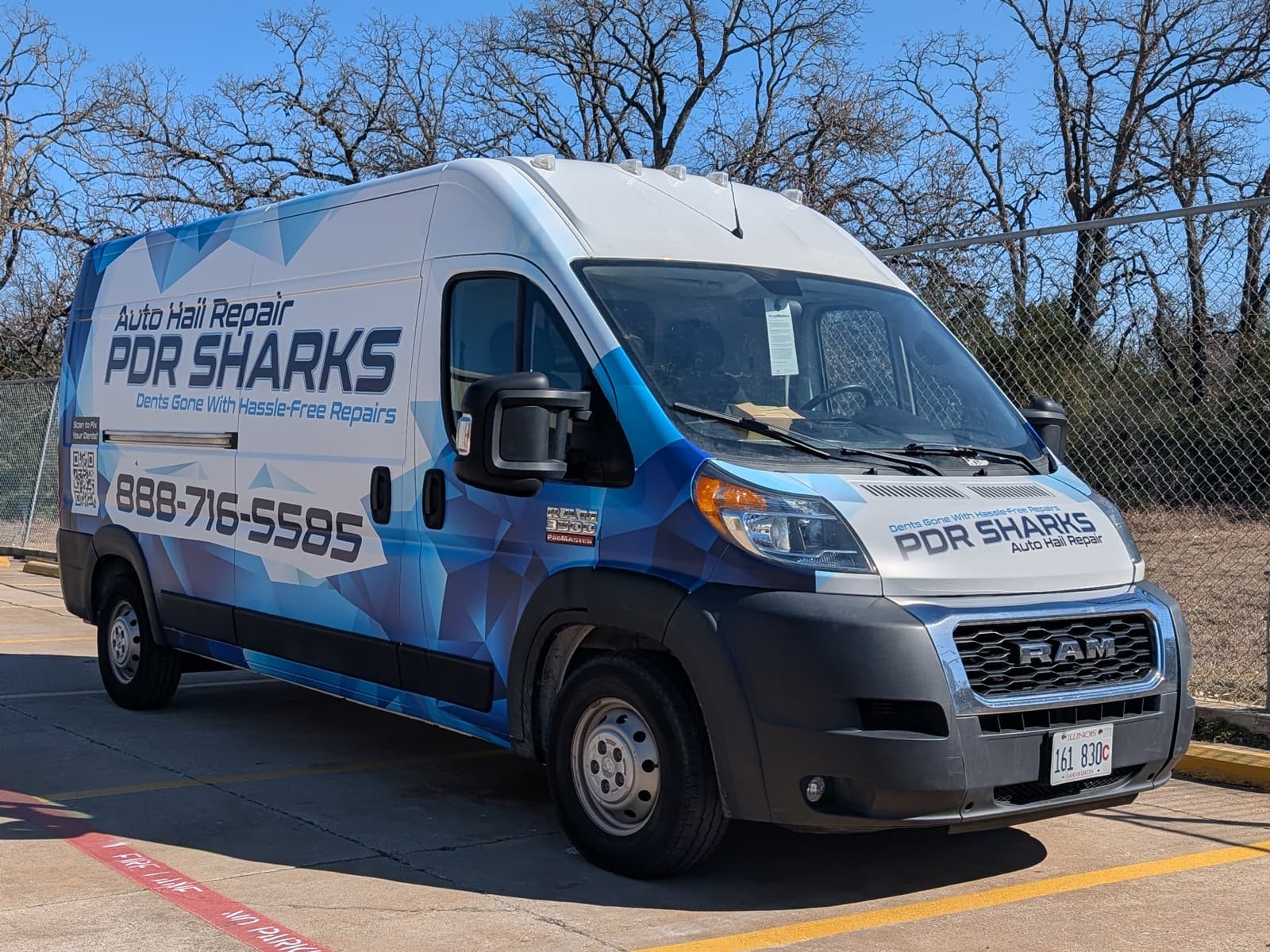
High contrast beats brand purity every time at traffic speed. White text on a dark background reads at distance better than any other combination. Dark text on a white vehicle is the second choice. Any combination where the background and text are similar in value, navy text on blue, red text on orange, becomes illegible before the vehicle clears an intersection.
Limit the primary layout to three colors or fewer. More colors divide attention and make the layout feel busy before a single word is read.
Avoid gradients in primary text elements. Gradients that look sharp on a monitor flatten at distance and reduce contrast in unpredictable ways.
What the wrap is made of matters
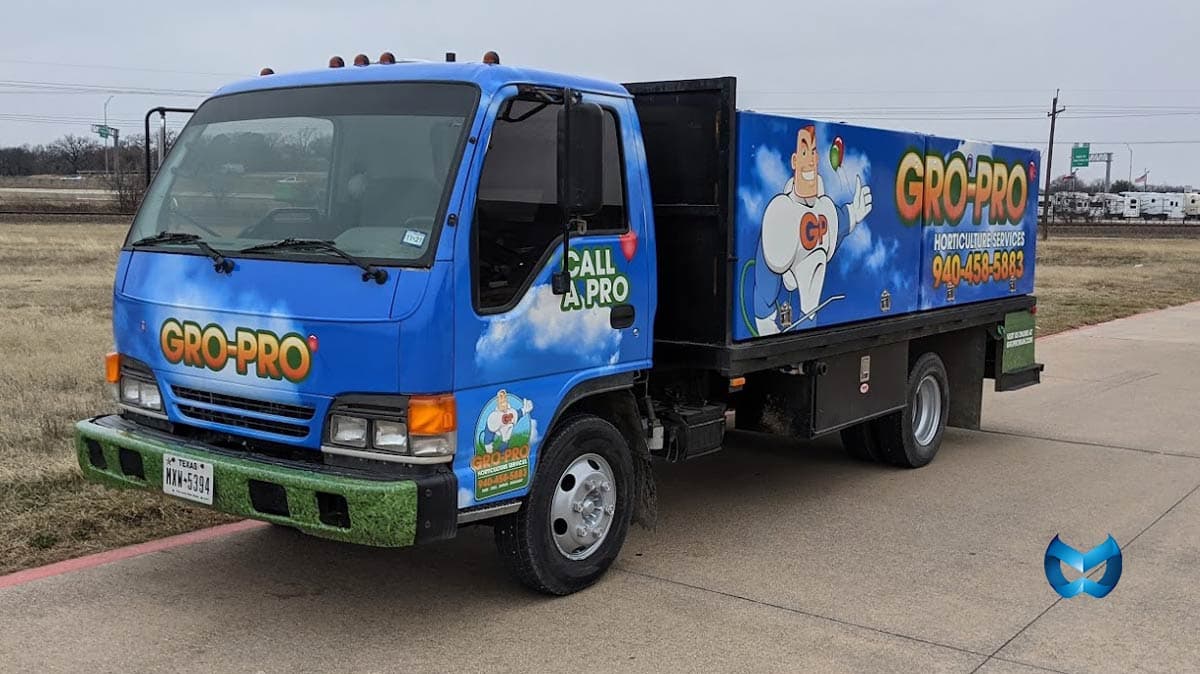
The vinyl grade and installation environment determine how long the wrap performs and how it holds up after two years of UV exposure, washing, and road debris. Saving money on materials costs more in premature failure and a second installation.
- Vinyl
- 3M premium cast vinyl is the correct choice for long-term fleet applications. Economy calendered vinyl stretches over compound curves, shrinks over time, and fails prematurely around door edges and mirrors.
- Inks
- HP Latex inks are UV-stable, which matters in Texas. Solvent inks fade faster and may off-gas volatile compounds during curing.
- Installation environment
- Vinyl must be applied in a climate-controlled environment. Temperature and humidity affect adhesion during application. Bubbles and lifting edges are almost always the result of installation outside a controlled bay.
- Warranty
- A 2-year limited warranty on workmanship and adhesion indicates the installer is confident in their materials and process. No warranty is a flag.
The most common wrap mistakes
- Tagline instead of service category. "Serving the Community Since 1987" tells a driver nothing about what you do.
- Phone number under 3 inches tall. Unreadable from the adjacent lane.
- Too many colors or fonts. Every additional element divides attention.
- Logo only with no service category. If your logo does not communicate your trade, a passing driver will not know what you do.
- Neglecting the driver's side. It is the highest-visibility surface on most routes, and most fleets under-design it.
- "Established" year instead of service information. Use the space for something that helps a customer decide to call.
Vehicle wrap FAQ
- How long does a professionally installed wrap last?
- A 3M premium vinyl wrap installed on a properly prepared surface lasts 5 to 7 years under normal conditions, and up to 10 years when garage-kept. WrapMasters backs every installation with a 2-year limited warranty on workmanship and adhesion.
- Can I use my existing logo on a wrap?
- Yes, if the logo file is vector-format (AI, EPS, or SVG) and prints cleanly at large size. Raster logos (JPG, PNG) can work if the resolution is high enough, but we flag any file that will degrade at vehicle scale before production begins.
- Do I need a new design if I just want to rewrap the same layout?
- Not necessarily. If the existing design is legible and performs well, we can reprint from the approved files. If the existing design has readability issues, we recommend addressing them in the new print run so you are not locking in another 5 years of a layout that is not generating leads.
- What is the difference between a partial and full wrap?
- A full wrap covers the entire vehicle. A partial wrap covers the rear doors, sides, or a defined section. Coverage is a budget decision, not a branding result. A well-designed partial that uses the factory paint as part of the design can brand a fleet as well as a full wrap, and often reads cleaner. A full wrap makes sense when the paint is faded or works against the brand colors.
- How long does a vehicle wrap last in Texas heat?
- Heat is not usually what ends a wrap in Texas. UV is. A cast vinyl commercial wrap installed to 3M specification lasts 5 to 7 years in North Texas, and it does not fade evenly. Horizontal panels, meaning the hood, roof, and upper door edges, take the most direct sun and go first, while vertical panels hold up longer. Covered overnight parking helps. WrapMasters installs cast film on every commercial fleet for this reason.
- How do I know if my current wrap is working?
- Ask customers how they found you. If 'saw your truck' is never the answer, the design may not be registering. A free wrap audit from WrapMasters evaluates readability, hierarchy, and recognition at speed and identifies specific issues.
Don't be a stranger.
Start with the free Wrap Audit: upload a side or rear photo and get your 45 MPH Test score in minutes. No cost, no commitment.
Prefer to talk now? Call 214-552-5165.