
How to Get ChatGPT and Gemini to Recommend Your Home Service Business
Chris Graham · September 26, 2026 · Updated September 28, 2026
Homeowners are starting to skip the search results page and ask ChatGPT or Gemini who to call. Type in "Who is a good plumber near Denton?" and you get a short list, sometimes a single name. If yours is not on it, that customer never sees you.
Nobody can buy a spot on that list, and nobody can promise you one. But AI assistants do not pick names at random. They recommend the businesses they can identify, describe, and find confirmed in more than one place. That part is in your hands.
Why AI recommends some businesses and skips others
An AI assistant builds its answer from what it can find and cross-check about a business. A company with the same name, the same service, and the same service area on its website, its Google Business Profile, its reviews, and other people's websites is easy to describe with confidence. A company with conflicting details, or with very little to read, is easy to skip.
It works the way a homeowner asking a neighbor works. The neighbor recommends the company they can name, describe in one sentence, and have seen around town. AI does the same thing, except it reads instead of driving past.
Three things do most of the work:
- Clarity: anyone can tell what you do and where you do it.
- Consistency: your facts match everywhere they appear.
- Corroboration: other people and other sites say the same thing about you.
Six steps to become the business AI recommends
-
Say who you are in one sentence, then say it the same way everywhere. Pick your business name, your main service, and your city, for example "Family-owned plumbing in Denton, Texas." Use that exact name, phone number, and address on your website, Google Business Profile, Facebook, LinkedIn, and every directory. Small mismatches, like two spellings of your name, make you harder to identify.
-
Answer real customer questions on your website. Give each service and each city you serve its own page. Write the question a homeowner would type as the heading, then answer it in the first sentence: what it costs, how long it takes, whether you serve their area. AI tools pull from pages that answer plainly.
-
Earn reviews that describe the work. "Great service!" tells a reader nothing. When you ask for a review, ask the customer to mention the service, the city, and what happened. Reply to every review you get.
-
Build your citations, then keep them identical. A citation is any listing of your business name, address, and phone number on a site that is not yours. Google Business Profile, Bing Places, Apple Business Connect, Yelp, the Better Business Bureau, your chamber of commerce, your trade association, a supplier's installer locator. These are the places an assistant goes to confirm that a company is real and is what it says it is. One mismatch, a suite number on one listing and not another, an old phone number on a third, and the tool either hedges or skips you. Beyond listings, every independent mention counts too: referral partners, local news, trade publications.
-
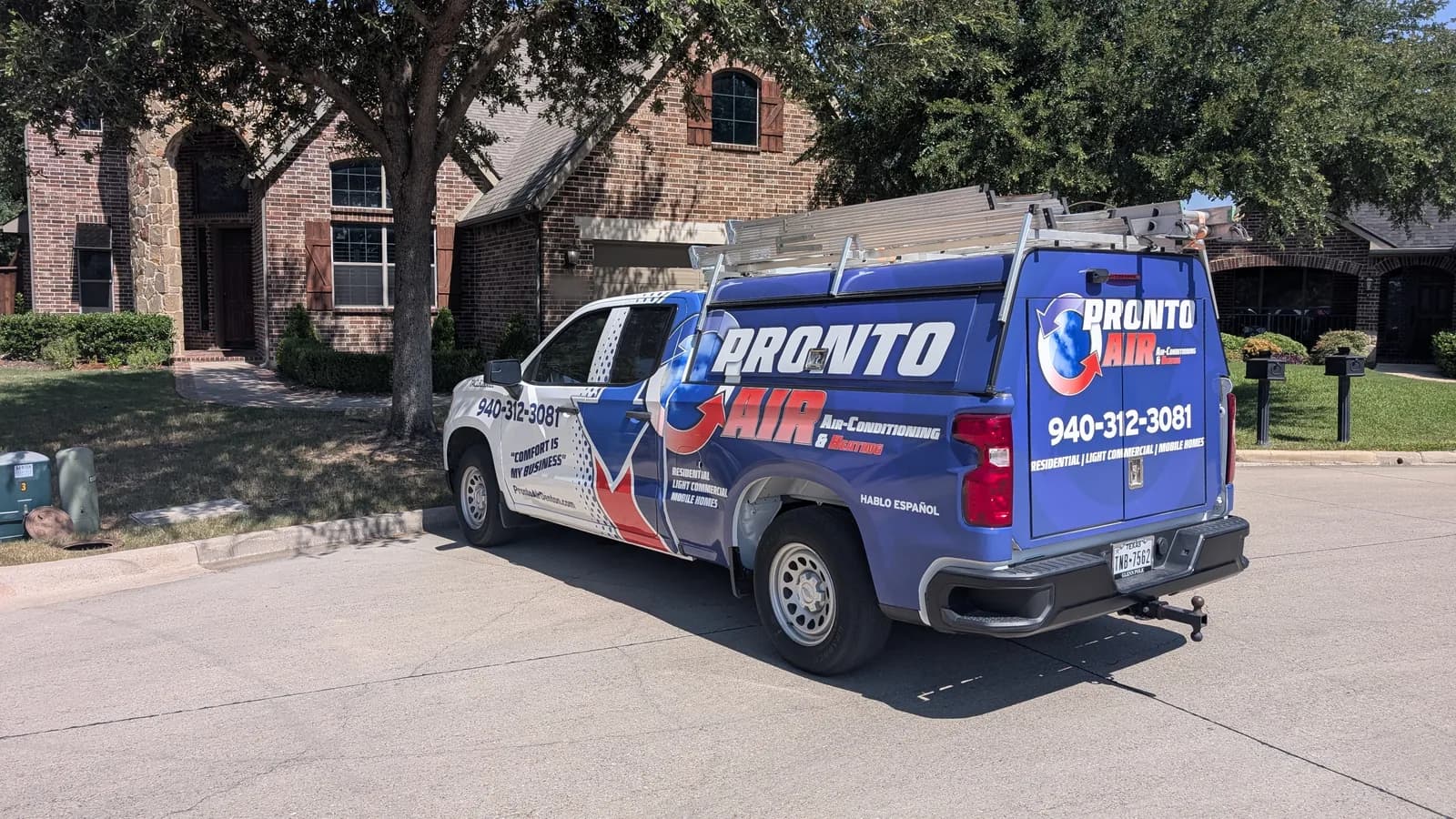
Make your trucks, shirts, and signs say the same thing as your website. Your service vehicles are the most-seen part of your brand. If the truck shows one name and promise while the website shows another, you split your own signal. The 45 MPH Test is a simple check: company name, service category, brand promise, contact path, and service area, all readable at speed.
-
Give machines a clean copy of the facts. Ask whoever manages your site to add LocalBusiness schema markup, make sure your pages load without JavaScript, and confirm you are not blocking AI crawlers by accident. A plain-text llms.txt file is also worth adding. Not every AI tool reads it yet, but it costs little.
This is the idea behind Fleet-First Branding: the trucks, website, reviews, and messaging all support each other instead of working alone.
Where to build citations first
Of the six steps, citations are the one most owners skip, and they are the raw material an assistant uses to check whether you exist. Work down this list in order.
- Google Business Profile. Claimed, complete, correct hours, real photos, and every review answered.
- Bing Places. Smaller than Google for human traffic, and easy to dismiss for that reason. ChatGPT's web search has drawn on Bing's index, so a thin listing there costs you in the exact place you are trying to show up.
- Apple Business Connect. Feeds Apple Maps and Siri, and it is free.
- Facebook and LinkedIn. Both get read constantly, and both are usually out of date.
- Yelp and the Better Business Bureau. You do not have to love them. They get cited.
- Local and trade. Your chamber of commerce, trade associations, supplier and manufacturer locators, sponsorships, and any local news that has covered you. These are the ones a competitor in another state cannot copy.
Three rules make the difference between a citation that helps and one that does nothing:
- One version of your facts. Exactly the same business name, one phone number, one address format, everywhere. Decide whether you are "Suite 120" or "Ste 120" and never vary.
- Free listings only. You are there to be confirmed, not to buy leads. A paid lead platform is a different purchase with a different argument.
- Check them on a schedule. Every listing decays. Phone numbers change, hours change, someone edits your Google profile. A quarterly pass is enough.
Our local citation checklist has the full list, the nine checks to run on each listing, and the mismatches that cause the most trouble.
Test it yourself with ten questions
Open a fresh chat in ChatGPT and another in Gemini. Ask each of these, swapping in your trade and your city, and write down which businesses get named.
- Who is the best [service] company in [city]?
- Who should I call for [specific problem] in [city]?
- What does [your business name] do, and are they any good?
- How does [your business] compare to [competitor]?
- How much does [service] cost in [city]?
- Who do you recommend for [service] near [neighborhood or zip code]?
- Which [trade] companies in [city] have the best reviews?
- Who offers emergency [service] in [city]?
- Which [trade] companies in [city] are family owned?
- What should I look for when hiring a [trade] company, and who fits that in [city]?
Run each question two or three times, because answers change from one run to the next. Then check again once a month.
If an AI names you with the wrong details, names a competitor, or names nobody, you have your to-do list. The gap usually traces back to one of the six steps above.
What nobody can promise
No one controls what ChatGPT or Gemini says. Answers differ between tools, between days, and even between two runs of the same question. Anyone who guarantees you a top spot is guessing.
What you can do is make your business easy to identify, easy to describe, and easy to confirm. Those same habits help you on Google, and they help the customer who finds you the old-fashioned way, by seeing your truck.
If you want to know where you stand, start with a free Wrap Audit to see how your vehicles pass the 45 MPH Test, or ask WrapMasters for a Free Brand Visibility Review.